How Much Does a Biomass Boiler Cost in the UK? (2025 Complete Price Guide)
Quick Answer: Total Installed Biomass Boiler Costs (2025 Estimates)
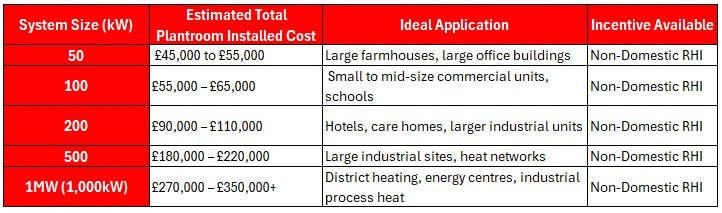
The total plantroom installed cost for a biomass heating system in the UK in 2025 varies significantly based on size, fuel type, and complexity, but generally ranges from £45,000 for a small commercial 50kW system up to over £300,000 for a larger 1MW industrial installation.
For a typical, high-quality 100kW biomass boiler system—the most common size for SMEs, large farms, or commercial buildings—you should budget an installed price between £55,000 and £65,000. This figure includes the boiler unit, flue, thermal store, fuel delivery system, and all mechanical/electrical labour.
While the upfront cost is higher than fossil fuel alternatives, utilising the current Boiler Upgrade Scheme (BUS) grant for domestic/small non-domestic projects (up to £7,500) or the Non-Domestic Renewable Heat Incentive (closed to new applicants but you can still benefit as detailed below in further sections), in combination with substantial fuel savings mean the Return on Investment (ROI) remains highly attractive, often achieving a payback period of 4 to 8 years depending on the scheme.
The Comprehensive Biomass Boiler Cost Breakdown
It’s crucial to remember that the boiler unit itself makes up only around 45% of the total plantroom project cost. The remaining 55% is attributed to essential components, installation, and commissioning. When budgeting, you must account for this complete installation package.
I. Biomass Boiler Unit (Approx. 45% of Total Plantroom Cost)
The price of the boiler unit depends on three primary factors:
- Size (kW): Larger boilers are generally more expensive but offer economies of scale, resulting in a lower cost per kilowatt (kW).
- Manufacturer & Quality: Premium European brands that offer robust technical support, higher efficiency, and lower emissions will command a higher price point than cheaper alternatives. Some of the biomass boilers we offer can be seen here.
- Fuel/Feed System: Log Boilers: Generally the lowest cost due to manual feeding and simpler engineering. Pellet Boilers: Mid-range cost, highly automated, and require a dedicated pellet store. Chip Boilers: Slightly more expensive than pellets due to the robust, heavy-duty mechanical equipment required for handling and feeding wood chip fuel.
II. Installation and Peripheral Costs (Approx. 45% of Total Plantroom Cost)
The costs below cover the vital infrastructure required to make the system safe, efficient, and operational:
- Fuel Storage & Delivery - The required size and type of fuel store (silo, bunker, or external store) and the automated feed system (auger or vacuum) that moves fuel into the boiler. This is a major cost variable
- Thermal Store (Buffer Tank) - Essential for system efficiency and lifespan. It stores the hot water generated by the boiler, ranging from a few hundred litres for domestic systems to many thousands for commercial projects.
- Flue System - Required to safely remove combustion gases. Ensuring correct draft through the biomass boiler is also crucial to allow efficient combustion. Costs are determined by height, material, and site-specific complexity.
- Pumps - Required to move the water round the heating circuit. Costs can vary depending on the size required, which is a function of the volume of the fluid that needs to be moved and over what distance.
- Heat Meter - Records the generation of the biomass boiler. This is crucial for systems that are going to be registered on the non-domestic RHI as the kWh recorded on the meter are used to calculate RHI payments.
- Valves - Required to direct flow and isolate components to allow for easy removal and replacement without having to drain the whole system.
- Pipework and Fittings - Required to connect all components.
- Mechanical & Electrical Labour - Installation of all pipework, wiring, control panels, and pumps to integrate the biomass system with your existing heating distribution network.
- Commissioning, Testing & Training - Final system setup by qualified engineers, efficiency testing, balancing, and training for the end-user. Necessary for warranty and compliance.
III. Cost of Work Downstream of the Plantroom
Outside of the plantroom the scope of works can vary significantly and really a detailed site survey is needed to be able to price this accurately. Prices can vary significantly depending on the complexity.
At one end of the spectrum is the boiler being located within the building being heated and the connections on to the existing heating system are very simple. If this is the case the prices detailed below show cover you.
At the other end of the spectrum is a large district heating scheme that involves km of underground pipe to connect multiple buildings which all need heating systems installed.
2025 Updated Price Tables by System Size
The following tables provide estimated total plantroom installed costs for high-quality, fully automated wood pellet or chip systems in the UK. Prices are estimates and exclude VAT.
1. Commercial and Industrial Biomass Systems (50kW – 1MW)
These figures typically cover systems for large businesses, industrial facilities, public sector buildings, and district heating schemes.
2. Domestic and Small Commercial Biomass Systems (10kW – 40kW)
These figures are relevant for homeowners, very large domestic properties, or small rural businesses currently using oil or LPG.

Financial Incentives, Grants, and Return on Investment (ROI)
Significant government support and financial savings still make biomass a sound investment.
1. The Boiler Upgrade Scheme (BUS)
A government support in England and Wales is the Boiler Upgrade Scheme (BUS).
- Grant Value: Currently offers a £7,500 non-repayable grant towards the cost of purchasing and installing a biomass boiler.
- Eligibility: Must be replacing fossil fuel heating (oil, gas, or electric) and must meet strict air quality standards (must use wood pellets/chip and have an emissions certificate). The property must also have a valid Energy Performance Certificate (EPC).
- Boiler size: Limited to biomass boilers up to 45kW
- Application: The installer applies for the grant on your behalf, and the £7,500 is deducted directly from your final bill.
2. Non-Domestic RHI
The non-domestic RHI pays participants each quarter for every kWh of heat generated and used over the past 3 months, with the scheme lasting 20 years. Whilst the scheme is now closed to new applicants, boiler and RHI tariffs can undergo changes of ownership as well as relocations to other sites, so a new owner can benefit from the RHI for the remaining term. As the capital expenditure on commercial projects is typically paid off in around 4 to 8 years, this means installations that are 10 years old could be relocated, with the capex of the second owner paid off, who then have 2 to 6 years further of RHI payments that they can benefit from. The payments are index linked as well, so the rate per kWh increases each year in line with the consumer price index. Further details on this scheme can be found on the RHI section of this website. We have produced a news article titled "What biomass boiler grants are available in the UK?" which goes into this area in more detail.
3. Scottish Government Funding (Home Energy Scotland)
Home Energy Scotland, funded by the Scottish Government, offers bespoke financial assistance for homeowners to install energy efficiency and low-carbon heating technologies, which includes biomass boilers.
- Interest-Free Loans: The flagship offering is an interest-free loan to help spread the cost of improvements, including the installation of low-carbon technologies.
- Grant Component: Grants may also be available depending on the improvement type and location. A rural uplift is also offered to homeowners in rural and island areas to help offset increased costs.
- Guidance: Home Energy Scotland acts as the primary point of contact to determine eligibility and guide the application process.
4. Commercial Tax Benefits and Capital Allowances
For commercial biomass installations, the primary benefit comes from tax relief:
- Capital Allowances (AIA): Businesses can use the Annual Investment Allowance (AIA) to claim 100% tax relief on the purchase of qualifying plant and machinery, which includes biomass boilers. This allows the cost of the system to be offset against taxable profits in the year of purchase.
- Fuel Savings: Switching from expensive fossil fuels like oil or LPG to wood pellets or wood chip offers huge operational savings, driving the overall ROI.
5. Calculating Payback Time
Due to increased system costs and fluctuating fuel prices, the typical payback period for a commercial biomass system is currently estimated to be between 4 and 8 years, depending heavily on the displaced fuel source and the annual heat demand, and scale of the installation. The payback calculation is simplified as:

Are you wondering if biomass heating will work for you?
Speak to our team on 01884 250 790
Frequently Asked Questions (FAQ)
- Is a biomass boiler worth the investment in 2025?
Yes, absolutely. While initial costs are high, the investment provides three major long-term benefits: significant annual fuel savings compared to oil/LPG, access to government grants (BUS or RHI), and crucial progress towards decarbonisation targets for your business or property. Systems typically pay themselves back in 4 to 8 years depending on the complexity, and you can then benefit form any remaining RHI term and fuel savings moving forward.
- What is the typical lifespan of a biomass boiler?
A high-quality commercial biomass boiler, when properly maintained, typically has a lifespan of 20 to 25 years. This longevity, combined with low running costs, ensures a strong return over its service life.
Due to the longevity it's important you go for both a reputable installer as well as manufacturer who will likely be there to support you throughout the lifetime of your system. Over the past years we have been contacted by many people that regret going
- Are wood pellets or wood chips cheaper?
Wood chips are generally the cheaper fuel option per kWh. However, wood chip systems are more complex and require larger, purpose-built storage and handling infrastructure, which increases the initial installation cost compared to a pellet system.
The costs provided here are estimated budgets. For a detailed, site-specific quote tailored to your heating load, fuel preference, and access to the BUS grant, please contact our technical sales team directly.
Treco and Author Experience
Treco are the UK's leading biomass boiler supply and installation company. We have operated for 20 years and during that time supplied over 1,000 biomass boilers. Along with supplying and installing biomass boiler systems to end users, we also acts as distributors for some of the top Austrian manufactures where we sell boilers to trade and provide them with technical support.
The author Ben Bevan is a director at Treco and has been involved with the company for 15 years. During this time he has worked on a wide scope of projects from domestic up to multi MW industrial systems. He is heavily involved in the pricing of the biomass boiler installations, so is well placed to author this article and provide advice to customers.